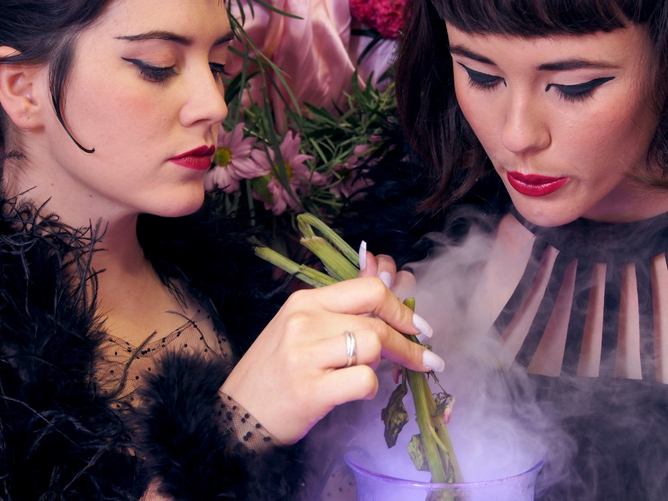
“Olfactory art†– art concerned with smell – is currently a relatively minor field. But a growing number of contemporary artists are starting to explore the potentials of olfactory art. [Last] year’s Next Wave festival in Melbourne presents Smell You Later (May 1-11), a series of “scent-based encounters†in bathrooms, corridors, lobbies and stairwells of various festival venues.
The sense of smell is often an issue in public discourse. Current odorizing and scent marketing practices are under critical scrutiny. The current documentary Stink! appears as a challenge to the industry. Continue reading STINK! Documentary→
An excellent must-read academic piece by Larry Shiner on the confusing but ever-relevant subject of perfumes are art. (For our brief take on the matter, see The Art of Scent & The Scent of Art.)
Claims that perfumes are art have been made before, but a recent art museum exhibit of a dozen perfumes under the title ‘The Art of Scent’ has raised the issue with a new insistence, although with an absence of theoretical justification. Part 1 of the paper develops an aesthetic case for perfume as an art form by answering Beardsley’s and Scruton’s arguments against odours (and implicitly perfumes) as the basis for aesthetic objects and works of art. Part 1 concludes that perfumes can in fact manifest the required structure, temporality, symbolism and expressivity for art status. Part 2, on the other hand, develops a contextualist case against perfumes as works of fine art by analyzing a typical contemporary art practice involving a perfume and arguing that, by contrast, typical perfumery practices lack crucial elements required to make perfume an art form and that perfume should be considered one of the design arts. Part 3, instead of trying to reconcile the impasse between the conclusions of Parts 1 and 2 with a theory of the fine arts that combines aesthetic and contextual elements, instead chooses to follow Dominic Lopes’ proposal that in resolving claims to art status we pursue analogies and ‘paths’ offered by the established individual arts. Using music as an example of a long established art form and the art quilt as an example of a recently established art, I suggest what it might take for ‘art perfumes’, or more accurately, ‘art scents’, to emerge and become justifiably included among the fine arts.
The aroma of freshly brewed coffee in the morning has to be one of the best scents ever but, along with many natural fragrances, it could soon vanish due to climate change. The Ephemeral Marvels Perfume Store (T.E.M.P.S., French for time) bottles the scents that are set to disappear because of the environmental crisis:
Graphic designer Sarah Hyndman believes typography says more than most people think it does. She thinks the shape of a letter can impact the way stuff tastes, smells, and sounds. To her, typefaces are multi-sensory experiences that affect the way we interact with the world around us.